


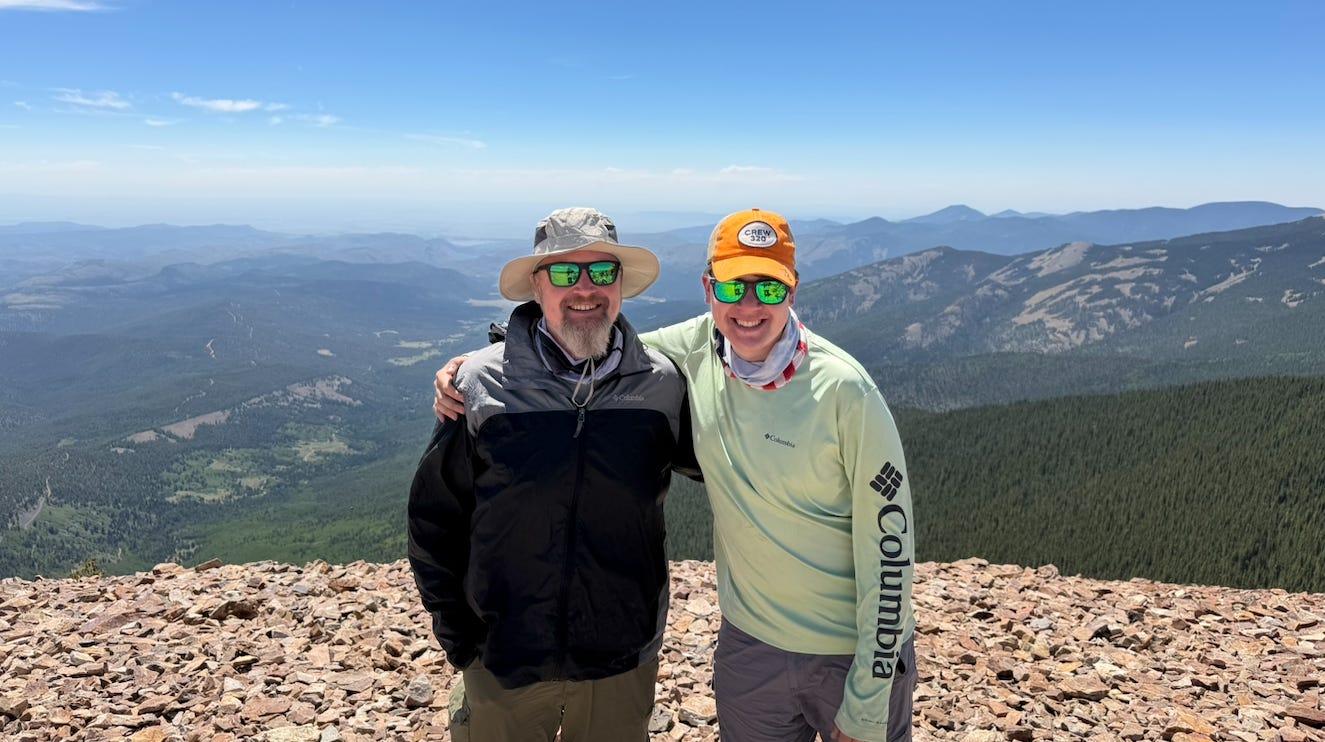
I spent the middle of June at Philmont Scout Ranch in New Mexico with my oldest son. We were gone for fifteen days, twelve of them backpacking with our crew. We hiked more than 100 miles and summited the tallest peaks I’ve ever climbed.
For most of that time I had no cell service. I thought being cut off from X, LinkedIn, Reddit, Slack, and everything else would give me hours to think. Instead, my brain went into recharge mode. I wasn’t working through big ideas on the trail. I was paying attention to water, weather, the next climb, and whether my feet were going to make it another ten miles. It was great.
Before I left, I finished and scheduled one more Focus Over Features post. It was the piece about AI coding costs and the fact that the meter is always running. It went out while I was at Philmont, so the newsletter kept moving even when I wasn’t. Then I got home, and it stopped.
The list of ideas was still there, drafts were sitting where I’d left them, and the next few posts were roughly planned. But I couldn’t sit down and pick up at the next bullet point. I had lost the thread, and that’s the honest reason this restart took a few weeks.
I don’t want to force a productivity lesson onto a backpacking trip with my son. Some things are worth doing without turning them into content. But coming back did expose a problem I’ve been running into everywhere else I use AI: it’s getting easy to keep work moving, but it’s still hard to know where to pick it back up.
A scheduled newsletter can publish without me. An agent can keep coding after I move on to something else. A research session can produce a pile of useful material. All of that is real progress, but it doesn’t solve re-entry. When I return the next morning, I still need to figure out what we were trying to do, which decisions were made, what changed, what’s unresolved, and what should happen next.
My own workflow has made this hard to ignore. I might talk through a product idea with Claude, move into Claude Code when I’m ready to work in the repository, use Codex for a separate review or implementation pass, and have OpenClaw working on research or another project in the background. Even inside what feels like one company’s set of tools, the pieces don’t really know about each other. A conversation I had with Claude doesn’t automatically become useful context in Claude Code, and Claude can’t simply reach into an old Claude Code session and tell me what happened there. Codex has its own sessions and context. OpenClaw has another set. The code may live in Git, but the reasoning, tradeoffs, rejected ideas, and unfinished questions are scattered across all of them.
Projects make this worse. I can bounce from the task and context tools I use for my own projects to a client project to this newsletter in the same day, using several of the same tools for each. By the end of the week, I remember having an important conversation about something, but not always where it happened. Was it in a Claude chat? A Claude Code session inside one repository? A Codex task? A page in Clarabit? A Slack thread? Sometimes search helps. Other times I end up opening tabs and reading old sessions until I recognize what I was thinking.
At that point, I’m not continuing the work. I’m piecing together enough of its history to understand it again.
This is already a problem when I’m handing work back to myself. Add another person and the number of gaps grows quickly. They don’t have the half-remembered context in my head, they may not have access to every tool or session I used, and they don’t know which artifact I considered final. To hand the work over, I have to gather the relevant chats, code, documents, links, decisions, and open questions, then explain how they fit together. If that person brings in another agent, the same material has to be packaged again in a form that agent can use.
A thoughtful handoff can solve the immediate problem. I’ve written good handoffs and received some excellent ones. But every good handoff required someone to stop doing the work and reconstruct its current state from the trail it left behind. The better and more complicated the work, the more effort that reconstruction takes.
AI makes that cost show up faster because it creates more trails. Teams can generate code, designs, research, account plans, support responses, marketing copy, and product ideas faster than they can absorb them. Each agent and tool adds another place where a decision can be made, an assumption can change, or a useful artifact can get stranded. The issue usually isn’t that an AI forgot something. It’s that nobody can easily tell which parts of the accumulated output are still true.
I’ve felt this most directly in software development because that’s where I run the most agents, but it isn’t just an engineering problem. A product team can have customer research in Slack, a prototype in Figma, requirements in a document, and three AI chats that reached slightly different conclusions. A sales team can generate a solid account brief but lose track of which claims were verified. A founder can spend a week exploring strategy with AI and end up with 50 pages of reasonable-sounding material and no clear record of what they actually decided.
The tools mostly organize this work around where it happened: a chat, a coding session, a task, a document, a repository. None of those is a complete view of the work itself.
An NFX piece that Scot Wingo highlighted this morning argues that the simple AI wrapper is dying and that the stronger products will own an entire workflow. One of its examples starts with building a system of record, then using AI to turn it into a system of action. I think that’s directionally right, but my own work exposes a complication: the whole workflow rarely stays inside one product. It crosses tools, models, people, repositories, and companies, and I don’t think the answer is forcing all of it into one giant application. Whatever becomes the system of record has to follow the work across those boundaries instead of creating one more place where context gets trapped.
I’m starting to think we need something that sits above the individual tools and keeps track of the current goal, the decisions that still stand, the open questions, the latest useful artifacts, and the next action. The history should remain available, but reading all of it shouldn’t be the price of getting involved.
That’s what I’ve been trying to solve in the tools and workflows I use for myself, and it’s also where I want to take Focus Over Features next. I’ve spent a lot of time here writing about agentic development: how agents change the software lifecycle, where human judgment gets skipped, why costs become harder to see, and what happens when generation moves faster than review. I still care about all of that, but the same problems are moving outside engineering. As more people use AI for real work, they’ll need ways to move that work between people, agents, tools, and days without rebuilding the context at every handoff.
The next useful AI products won’t only help agents do more. They’ll help us understand what happened, decide what still matters, and give the next person or agent a reliable place to continue.
I’m not treating this as a big relaunch or promising some heroic publishing schedule. I’m picking up with the question that was waiting for me when I got back: when work can keep running without us, how do we make sure we can still understand it when we return?
If your work is scattered across AI tools too, I’d like to hear how you’re handling it.