


Last week I walked through why most AI coding rollouts stall; the operating model around the agent doesn’t catch up fast enough with the tools. I said I’d come back this week with what’s actually working in the teams that have pushed past that stall.
I’m going to get there, I promise. But I’ve noticed a pattern in my own work with agents that I’ve been discussing with others, and I’m realizing a growing number of teams are starting to suffer from the same thing. They don’t all describe it the same way. They don’t always notice they’re doing it. But it’s the kind of thing that, once you spot it, you can’t really unspot.
I think it deserves a name. And I’m going to borrow one, from a different industry.
The phrase has a history
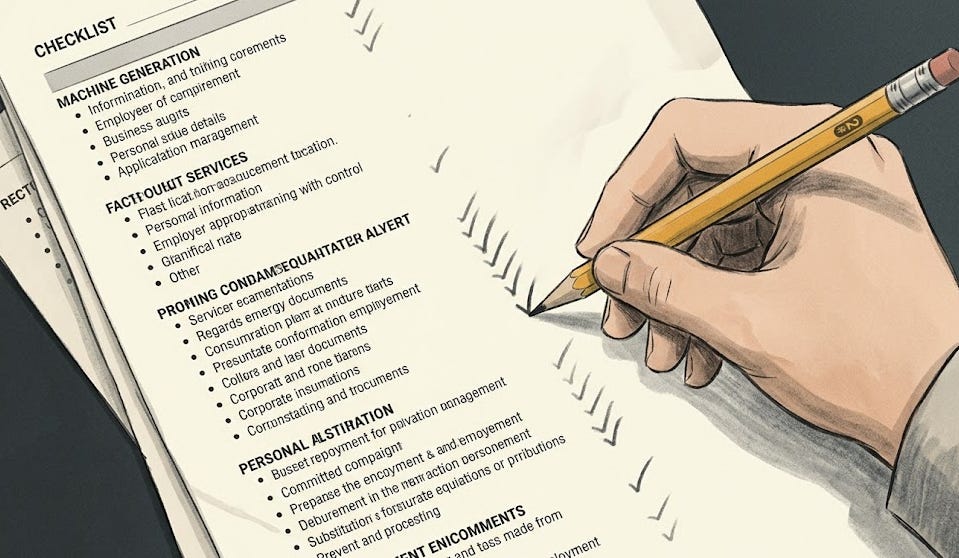
I learned the phrase pencil-whipping from a colleague at a previous company. He’d served in the military before he came into software. In military aviation maintenance (or nuclear plant operations, industrial safety inspections, etc.), pencil-whipping is what you call it when someone signs off on a checklist without doing the actual inspection work behind it.
The person was supposed to verify that the part was installed correctly, the valve was in the right position, the seal hadn’t aged out. They didn’t. They moved the pencil across the page; check, check, and check. The form said the work was done. The work was NOT done.
It’s not a small term in those communities. The FAA writes it into oversight reports. The Navy has had to discipline it. The nuclear industry has had public failures rooted in it; the Davis-Besse incident in 2002, where a corroded reactor head went undetected for years, was traced in part to inspections that had been pencil-whipped. The cost of approving things you didn’t actually look at can be very high in these industries.
The original sense of the phrase carries some hint of deception. The person knew they were skipping the work. They signed anyway. I want to use the term in a context where the failure looks more like overwhelm than dishonesty; but the underlying problem is the same. The approver didn’t do the work the approval was supposed to represent.
Pencil-whipping the agent
The phrase accurately describes a growing trend I’m seeing in AI-native software work right now.
It works the same way. The agent’s plan is the form. You’re the inspector. Approving the plan is supposed to represent the actual review work; you reading it carefully, thinking about whether it fits the system, catching the assumptions that don’t hold, deciding the path is right.
And what I keep noticing, in my own work and in the teams I talk to, is that approval is happening without that review.
The agent proposes a plan. The plan looks reasonable. There are five decisions buried in it, each one you’d normally want to weigh in on. You read the first two and default the rest. Approve. Continue. The agent produces code. You read the first part of the diff and skim the rest. Looks good. Merge. CI passes, right? Repeat.
Nobody’s being deliberately deceptive. Nobody’s trying to skip work. You meant to review. You opened the plan with every intention of thinking about it. But by then you had three other agent sessions waiting on input, a Slack thread asking for a decision, an email about a meeting, and the next plan was probably going to look a lot like this one anyway, and who are you to get in the way of the accelerating agentic-dev factory? So you moved the pencil across the page. Rubber-stamped. Pencil-whipped.
I admit, I’ve caught myself doing this... plenty of times. Last week, I had a screen full of terminal tabs with agent sessions in-flight. I opened the spec’d plan from one of them, read the first paragraph carefully, skimmed the second, and clicked approve. Later, when the agent coding session was complete and I returned to the tab, I realized I had no idea what it had actually built. The result was fine. But honestly, I hadn’t actually approved it. I’d just moved the pencil.
I’ve heard versions of the same story from every team I’ve talked to that runs more than one or two agents in parallel. One solo founder I spoke with described it as the moment when reviewing the plan starts to feel like the bottleneck. And yeah, I know how many LinkedIn posts have already used the phrase “the bottleneck has moved.” Too many. AI slop or not, the feeling holds. So you stop reviewing the plan. Another engineering lead described it as the slow realization that the team’s no longer making all the decisions; the agent is slowly taking over the role, going from coder to decision-maker.
The agent’s doing its job. It’s presenting a proposal for approval. The human’s job is the one that’s quietly changed under their feet.
Why it happens
Honestly, “humans got overwhelmed” is letting us off the hook. There’s something more specific going on, and it’s the artifacts themselves.
The plans agents produce are long. They’re dense. They’re written in the polished markdown an AI generates effortlessly and a human has to slog through. Eight sections. Twenty open questions. A whole appendix of acceptance criteria. Nobody actually wants to read all that end to end. So most people scan, scroll to the open questions, reason through a few of them, and send it.
That’s not a character flaw. It’s a rational response to a wall of text that wasn’t really built for reading. The agent wrote it because it was capable of writing it, not because it was the right size for the decision being made.
You see the same thing in the code diffs. The agent makes thirty file changes, half of them formatting or test scaffolding or pattern updates that don’t actually need eyeballs on them. The reviewer skims the boilerplate to find the parts that matter. By the time they hit the third or fourth real change, attention’s already fraying. They click approve on the rest.
The agent’s productivity isn’t matched by an artifact format that respects the reviewer’s time. We took the documents and the diffs and the prompts that worked when humans were producing them at human pace, and we asked AI to produce them at AI pace in the same format. That format doesn’t hold up at AI volume.
That’s the part I’m experimenting around right now. I think there’s a real solution in artifacts that respect the reviewer’s time, that surface the decisions instead of burying them in a wall of markdown. More on that in the coming weeks. For now, pencil-whipping is going to keep being the default; not because anyone wants to do it, but because the artifacts make any other behavior feel slower than the work allows for.
Inference is not a product strategy
And honestly, it’s not even a great trade-off when you stop and look at it. We went from YOLO prompts and one-shotting things, to having an agent develop a super detailed spec, reviewed by another agent, and we just skim it? We built a more elaborate stack to do the same shallow thing.
Spec-driven development is the smart way to push agentic dev forward. I’m convinced of this. The work of writing a sharp spec, deciding what should be built and how, gets harder to skip the more leverage agents give you. You front-load the thinking; the agent executes; the output matches the intent because the intent was actually thought through.
But if the specs are pencil-whipped, who’s really at the wheel of your product?
Inference is. When you scan a plan and send it without thinking through the decisions, you’ve handed the decisions to the model. The model isn’t malicious; it’s just doing what it does, which is producing the most likely statistical output for the kind of plan you asked for. That’s fine when the most likely statistical output is what you actually want. It’s rare in product work. Products that win are the ones that don’t average out; they have opinions, edges, deliberate calls about what to do and what to refuse to do.
Outsource enough of that to inference and your product becomes the statistical mean. Mediocre at best. Confusing and convoluted at worst, because LLMs trained on everything tend to compose plausible-but-incoherent product features when there isn’t an opinionated decision-maker anchoring them.
And the failure mode is slow. By the time you can feel that something’s off about the product, the team’s already several agent-shifts of work past the moment when a different decision could have been made cheaply. The rework isn’t a single bug; it’s an architectural mistake, or a misread of what the customer actually wanted, or a feature that looked right in the plan and feels wrong in the product. It’s the product itself.
Humans are supposed to be in the driver’s seat. The agent is the engine. The spec is the steering wheel. If you stop steering, the car still moves; it just doesn’t go where you decided to go. That’s not building product. That’s renting a car and letting it drive.
What the maturing teams are doing about it
The teams I see making this less painful have done something specific. They’ve separated the act of generating proposals from the act of deciding on them. The same person can still play both roles, but the roles themselves aren’t collapsed anymore.
One team I spoke with runs a clear split. One agent session shapes the proposal. A different session, with a different role, is the one that gets asked to approve. The two sessions hold different context on purpose. The proposer is optimistic. The approver is skeptical. The human is the tie-breaker, not the rubber-stamp. The volume of decisions didn’t go down; but the cognitive load of each approval went up, in a useful way, because the human had to weigh two framings instead of defaulting to one.
Another team treats the approval moment as a deliberate ritual. Before they accept a plan, they write down what they’d expect to see if the plan was wrong. Two sentences, no more. The act of writing forces the inspection. If they can’t write the two sentences, they can’t approve. Sounds heavy. It’s faster than the rework that follows skipping it.
A third pattern I’ve seen is the receipt. When an agent finishes a piece of work, it writes a short summary of what it actually did, what assumptions it made, and what it expected someone to come back and verify. The receipt is for the next session, not the current one. The team treats it as part of the deliverable; if the receipt doesn’t exist, the work isn’t done. And the receipt has a side effect: it forces the agent to be honest about what it skipped, which gives the human something concrete to inspect later, when the bandwidth is actually there.
None of these are big patterns. They’re not new tooling or new methodologies. They’re small habits. But they’re what protects the team from the failure mode of moving the pencil across the page without thinking.
Approval is its own job now
The bigger shift underneath all of this is that approval used to be a thin slice of an engineer’s day. You wrote code. You reviewed someone else’s code occasionally. You signed off on a design when one came across your desk. The approval moments were rare enough that they didn’t really need to be designed for.
But in an agent-native workflow, the ratio flips. You’re approving constantly. Every plan, every diff, every decision the agent surfaces, every fork in the road. The job that used to be five percent of the work is now a much larger share. For the practitioners I see pushing hardest into this style of work, it’s the majority of the day.
And we haven’t built our habits, our tools, or our team norms around that yet. We’re still treating approval like the rare event it used to be. So when the volume goes up, the quality of each approval goes down, and the pencil starts moving across the page.
I think this is the part that’s getting missed in the louder market conversation. The story everyone keeps telling is about agents getting more autonomous, models getting more capable, demos getting more impressive. Those things are real. But what the maturing teams are actually fighting isn’t on the agent side at all. It’s on the approval side. It’s the human moment where work gets ratified or rejected, and that moment is structurally underserved by every tool we use today.
That’s the layer where I think the next round of real progress lives. Not better generation. Better judgment.
The smaller call this week
None of this means slowing down. The teams that have pushed past the stall don’t move slower than the ones that haven’t. They move differently. They’ve re-allocated where the human attention goes, away from generating output and toward judging it. The output side has changed faster than most of us were ready for. The judgment side is just starting to catch up.
Next week I want to get more specific about what those patterns actually look like in practice. The forms approval takes when it stops being a checkbox and starts being designed work. The artifacts disciplined teams create so judgment can scale past one person sitting at one screen. The ways the strongest practitioners I’ve talked to have managed to slow the approval moment down without slowing the whole workflow down.
For this week, the ask is smaller. Notice when you’re doing it. Notice the difference between reading the agent’s plan and approving it. Notice the moment you decided to skim the diff because the next one was already coming in.
Once you can see the pencil moving across the page, you can stop.
This article nails it. The thing that keeps me out of the pencil-whipping trap is limiting how many features I have in flight. Too many and the fatigue sets in and I start rubber-stamping. The other half is front-loading the thinking: brainstorm, design, and plan before any code, so the hard decisions get surfaced and settled early. Then the spec and plan keep execution on track instead of being where decisions get outsourced to the model. Spec-driven really is the way.