


First time recording a video companion to my article. Watch, read, or both… your call!
I have to admit that a lot of my agentic coding sessions don’t end up the way I wanted them to. What it usually looks like: I start planning a feature with the shape of it in my head in a way that makes sense to me. It feels good, so I dictate the feature out, pass it off to an agent to build a spec, and review the spec (probably with not nearly enough detail). The spec looks fine at first pass. I might give a couple of updates or suggestions and then approve it for coding.
Then it starts coding and I move on to other tasks. Later I realize it got hung up on something that wasn’t fully figured out in the spec. I look through the options, give it some direction, and get the agent back to coding. It finishes, but since I’m usually multi-tasking I don’t realize it until the next day. CI passes. PR looks clean. The code looks clean. I fire up a session to UAT the feature and it just doesn’t feel like what I tried to build. It’s a close facsimile of what I wanted, but not what I had in my head. Somehow I didn’t give the right level of detail.
This is the part of agentic coding nobody really warned me about. Building isn’t the hard part anymore. The model can write the function, the file, the test. Even the small refactors I used to dread are cheap now. What’s actually hard is making product decisions at the speed an agent can produce.
That’s why I don’t buy the “coding is solved” line. Most AI coding tools are still behind on this part — and it’s the part that actually matters.
Where teams actually sit on the curve
Walk into any team using AI coding tools today and you’ll find them somewhere on a maturity arc. I think about it in four rough phases, mostly so I can figure out if I’m falling behind or keeping up with the wave of AI.
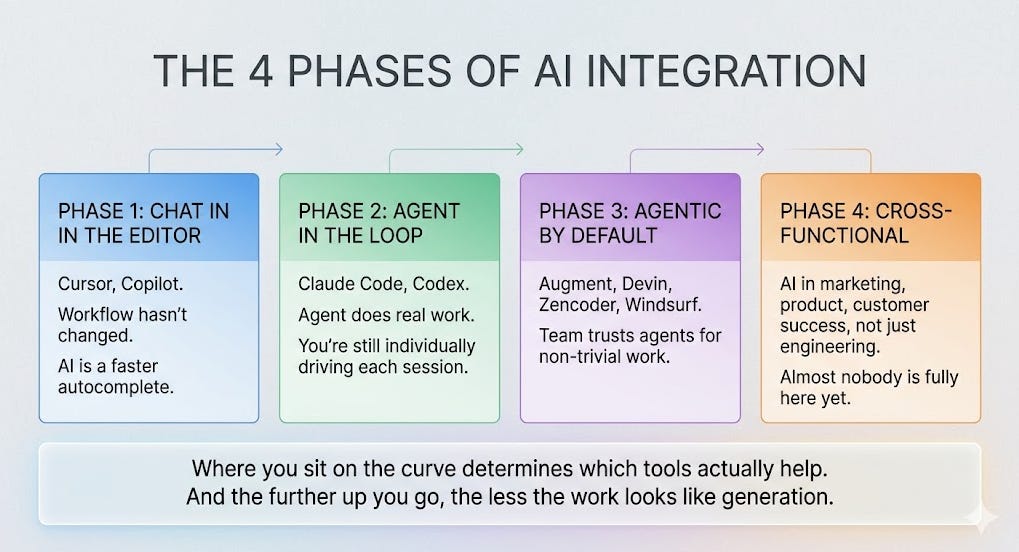
Phase 1 — chat in the editor. A developer pops up Copilot or Cursor’s sidebar, asks for a completion, accepts or rejects. The workflow itself hasn’t changed; AI is a faster autocomplete. Most developers actually live here, even now.
Phase 2 — agent in the loop. The developer moves into a harness where the agent can read files, run commands, propose multi-file changes. Claude Code, Cursor’s agent mode, Codex, OpenClaw. The agent does meaningful work, but a single human is still individually orchestrating each session — one conversation, one laptop open, one person at the wheel.
Phase 3 — agentic coding as default. The team trusts agents enough to default to them for non-trivial work. The senior people here start inventing role-separated workflows: a session for specs, a session for execution, a separate session that watches for stale work and reminds them what was open before lunch. Tools targeting this phase: Augment Intent, Devin, Zencoder, Windsurf. Real product, real momentum, and a lot of funding (Cognition just raised $1B at a $25B pre-money valuation; Augment raised another $227M).
Phase 4 — cross-functional AI workflow. AI has moved beyond engineering and across the rest of the company. The product manager researches customer discovery signals and writes educated specs with agent help. Marketing runs experiments against agent-generated drafts, optimizes ad spend, and builds a bigger pipeline. Customer success uses agents for tier-one response and for tracking onboarding signals, catching struggling new customers before they churn. Multiple disciplines coordinate through agent-generated artifacts. Almost no companies are operating at Phase 4 across every discipline. Many have strong pockets (usually in engineering) but the full cross-functional pattern is rare, and almost no tool serves it well.
Where a team sits determines which tools actually help. Cursor is a frequent first stop for Phase 1. Claude Code is the gravity-well of Phase 2. The well-funded developer-workspace startups are getting serious about Phase 3.
Phase 4 is where teams really need the most help. And the further up the curve a team gets, the more the work shifts from generating code to deciding what to build, what to ship, and what to throw away.
What the work actually is at each phase
At Phase 1, the constraint is how fast you can generate the line of code or method you’re after. The agent autocompletes the next thing you were going to type anyway.
At Phase 2, the constraint is thinking through what to build. The agent will gladly write anything; whether I’ve described the right thing is on me.
At Phase 3, the constraint is reviewing what got built. Multiple sessions running, multiple PRs landing, real code being merged. The question is whether I trust what the agent is generating.
At Phase 4, the constraint is making product decisions — across roles, across functions, across the dozens of small calls that get made when the agent has to fill in a gap. The shape of a button. The exact copy on an empty state. Whether the new feature shows up in the nav or stays buried under a settings menu. Each of these used to take a meeting or a Slack thread. Now they happen mid-session, by default, while I’m not looking.
This is the pencil-whipping problem. When the agent runs faster than I can fully scope each decision, I start defaulting to whatever it suggests. The defaults aren’t usually bad. They’re just the most likely outcome the model picked, which is the same default most other platforms would pick. So the feature ships looking like every other AI-built feature. Average. Mediocre. Not the thing I actually wanted to build.
The media keeps acting like coding is solved. What most AI coding tools are actually solving is the Phase 1 and Phase 2 problem — making generation faster. Generating code quickly isn’t the hard part anymore.
Why the old SDLC doesn’t fit anymore
We built the old software development lifecycle around human throughput. A product manager spends a week on a spec. Engineering takes a few days to estimate. A developer writes the feature over two weeks. Code review takes a day or two of back-and-forth. CI runs for twenty or thirty minutes. The whole thing ships in a sprint, plus or minus.
Each stage was sized for the people doing the work. None of them are sized for an agent.
When an agent can iterate in seconds and produce a working draft of a feature in an afternoon, the same lifecycle stops looking like a process and starts looking like a backlog. The agent is ready for a verdict; the verdict is still in the CI queue. The agent is ready for review; the human is still in last week’s review pile. Each stage that used to be a checkpoint is now a wait.
CI is the easiest example to point at, because the math is so clean. For most of my career a CI run typically meant a half hour wait — plenty of time to grab a coffee and get some fresh air. That was fine when humans pushed a few times a day. You context-switched while you waited, came back later, and dealt with the verdict. The cost was the wait, and you paid it once per push.
That model falls apart when the pusher is an agent iterating in seconds. If verification takes thirty minutes, the agent either sits idle waiting on a verdict it can’t act on, or (more likely) ships from the inner loop with whatever local checks happen to be in place. Mocked. Partial. The full-system verification gets pushed onto a human who is already stretched too thin.
As I’ve been building new code bases with AI, I’ve focused on making sure CI completes in under a minute, even as the code base grows. The reason isn’t comfort. It’s that the agent needs to be able to check itself, and a bloated list of meaningless tests wastes the agent’s time over and over. Without fast verification, every PR becomes another pencil-whipping decision.
CI is one stage. Spec review is another (adversarial review before the agent starts coding, not after). PR review is another (you can’t read twelve PRs in sequence — they need to be ranked, summarized, batched). Even discovery cycles are another (agents can react to feedback in minutes, but the loop to get feedback in front of a human still takes days).
I’m starting to see trade press notice this. A few recent pieces have argued the same thing in different vocabulary: that verification has to move up into the agent session, that pipelines built for human-paced shipping don’t survive contact with agentic work. They’re right as far as that argument goes. But CI is just one stage. Every stage of the SDLC needs the same rework.
Every stage that used to be sized for humans needs a feedback loop sized for the speed the agent runs at — and clear enough that a human can act on what comes back.
Multiple stages. Same pattern.
Other instances of the same pattern
Interactive artifacts attached to specs. When the agent is about to build something visual, I don’t want to read a paragraph describing what the empty state looks like, or what the UI layout looks like in ASCII art. I want to see it. A working prototype, even a rough one, makes the decision in seconds that the paragraph would take twenty minutes to describe clearly enough to understand. The artifact is the feedback loop.
Ranked human attention. When the agent surfaces twelve things that might need my input, I’ll triage maybe four of them properly and pencil-whip the rest. The mental load of constantly being pinged from different agents, different decisions, different stuck points, different contexts, is exhausting. A lot of people running real agentic workflows say they’re drained by lunch. Something that ranks what actually needs my judgment, versus what’s a safe default, lets me spend my attention where it matters.
Receipts that survive context loss. When I come back to a session many hours later, the agent’s working memory is gone and mine isn’t much better. Claude Code shows me a banner (”clear this session to save 600k tokens”) and I don’t want to clear it, because then I lose all the context — but I also don’t want to keep burning tokens fighting context limits. A short, structured receipt (what was decided, what was built, what’s still ambiguous) is the cheapest way to put me back in the loop. The receipt is the feedback to my future self.
Adversarial spec review before code starts. Pulling a second agent in to attack the spec for edge cases I missed is cheaper than finding them in a PR three days later. The review is the feedback at the front of the loop instead of the back. This upfront work also keeps me focused on one task longer, which gives the agent better instructions to work longer too. We don’t want to play whack-a-mole with our agents. Handing them half-baked specs (or no specs at all) and then trying to scale up to multi-agent work is literally asking for whack-a-mole. It’s not better.
None of these are new ideas. A lot of the people running real agentic workflows have already built some version of each one for themselves. The reason you don’t see them as products yet is they don’t look like the AI features companies are racing to ship. They look like the slow, unglamorous work of fixing the loops around the agent. That’s exactly where the work at Phase 4 actually lives.
What this means in practice
If I had to give one piece of practical guidance to a team trying to move up the curve, it would be this: stop spending your entire tool budget on code generation products.
The agents you already have are good enough at writing code. Spend the next dollar on whatever shrinks the loop between the agent producing something and a human being able to make a real decision about it. Getting better at this loop also means less wasted code generation, less tokens spent on rework, and real cost savings across the product org.
That looks different for every team. For some it’s CI engineering. For others it’s better attention ranking, or just a discipline around receipts and small specs. The common thread is the work is unglamorous, the payoff shows up over months not days, and almost no off-the-shelf tool will do it for you yet.
The companies that figure this out first will have the durable advantage in this category. Not because they have a better agent (everyone has access to roughly the same agents) but because they have a better operating system around the agent. Cheaper decisions. Faster judgment. Less pencil-whipping.
Generation got cheap. Deciding didn’t. If you have already done the work to make generation cheap for yourself, you already know the next set of tools won’t matter unless they do something about the other half of the problem. That’s the half I’m writing for.